
![[EN] Can you use an English SaaS contract with a French customer?](https://gwvckixiegkllthleuyt.supabase.co/storage/v1/object/public/workspace-article-images-public/ba761040-abd2-462c-9e25-c3f126496a31/featured.jpg)
An English-language SaaS contract is enforceable with a French customer, and it's the default choice for B2B software deals signed in France in 2026. The catch sits in two places: Loi Toubon can force a French version for individual consumers, and mandatory French Commercial Code rules apply no matter what language sits on the page.
- An English SaaS contract is valid with French business customers in 2026 if both sides understood and negotiated the terms.
- Loi Toubon requires a French version for consumer-facing SaaS terms, invoices and app listings sold to individuals in France.
- French Commercial Code rules on unfair terms and payment deadlines override an English contract when performance happens in France.
- A missing governing-law clause doesn't default to English law — it opens the door to a French court applying French rules.
- Lina drafts and reviews SaaS contracts in English or French for founders selling into France, with a senior lawyer signing off.
Why this matters
Every SaaS founder closing a first French logo asks the same question before signing: does the English master service agreement actually hold up. Get it wrong on a B2C product and the contract is exposed on a technicality that has nothing to do with the deal terms. Get it wrong on a B2B deal and the risk is smaller, but a dispute in a French court still runs slower and costs more when the only version on file is in English. Lina reviews SaaS contracts for exactly this gap between what founders assume and what French law actually requires.
For an English SaaS contract, France draws one hard line: who the customer is. A French enterprise buyer signing a multi-year subscription is a different legal animal from a French consumer clicking "I agree" on a freemium checkout page, and the language rules treat them differently.
Can you use an English SaaS contract with a French customer?
Yes for business customers, no as the sole version for consumers. The table below breaks down what changes by customer type.
| Customer type | English-only contract valid? | French version required? | Key risk |
|---|---|---|---|
| French business (B2B) | Yes, if both parties negotiated and understood the terms | No, but recommended for faster deal cycles | A French court can order a certified translation mid-dispute |
| French individual (B2C) | No, not as the sole version | Yes, under Loi Toubon and the Code de la consommation | Consumer-facing terms can be deemed unenforceable if only in English |
| French public sector or regulated buyer | No | Yes, French is mandatory for official dealings | Contract can be challenged on form alone |
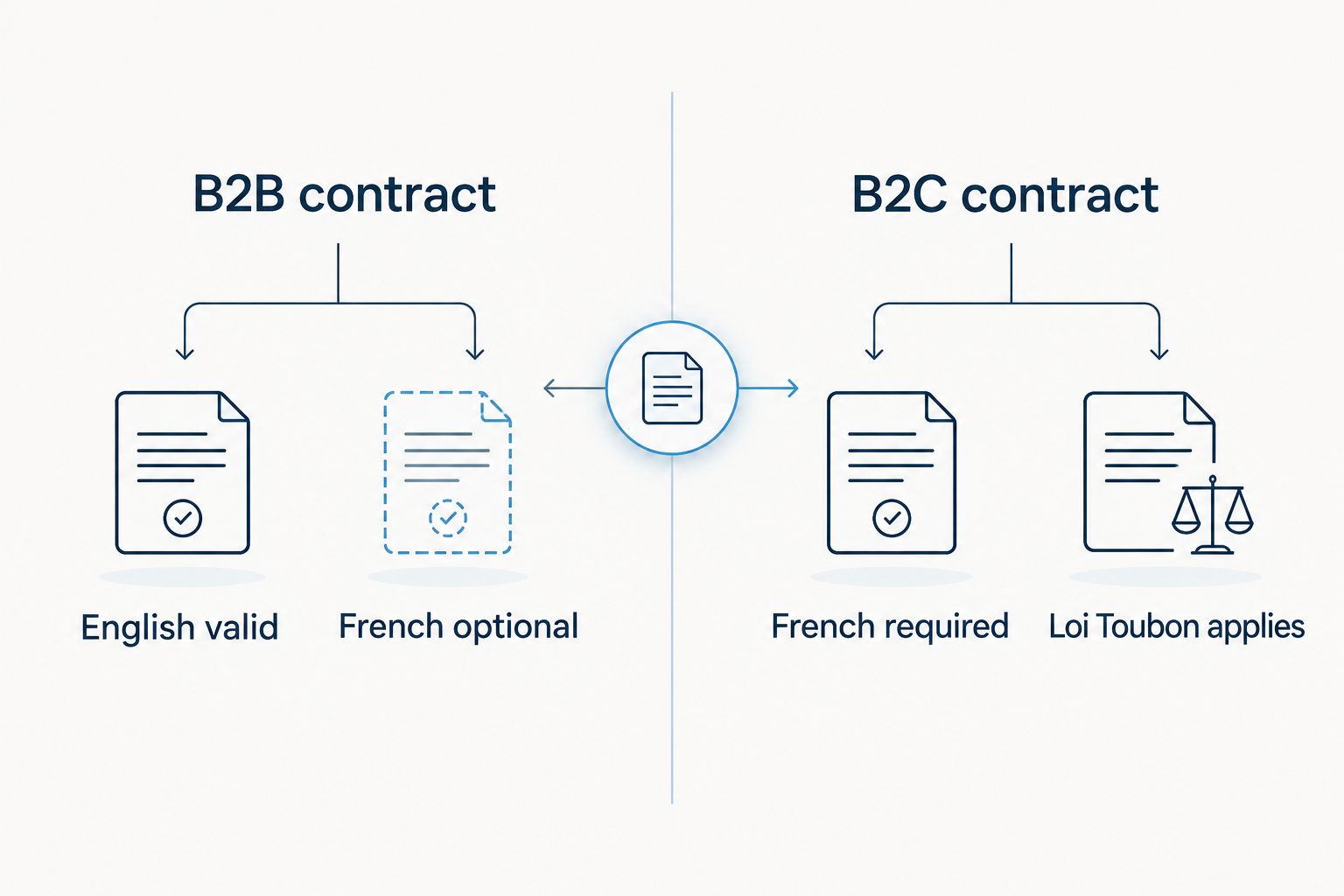
B2B SaaS contracts: English works, with limits
French law does not require commercial contracts between two businesses to be drafted in French. French courts, including the Cour de cassation, have repeatedly upheld English-language B2B contracts where both parties negotiated the terms and clearly understood them at signature. That's the standard shape of a SaaS agreement between a vendor and a French corporate customer in 2026.
The limits sit around three things:
- Data protection annexes. If the SaaS product processes personal data, GDPR compliance work doesn't require French, but French data controllers often ask for a French-language data processing agreement for their internal compliance file, even when the master agreement stays in English.
- Employment-adjacent clauses. Anything that touches a French employee directly — a secondment clause, a non-solicit tied to named staff — sits closer to labor law, where French-language requirements are stricter than for a pure commercial contract.
- Public procurement. A French public body buying SaaS almost always requires French, regardless of contract size.
Outside those three cases, an English SaaS contract signed with a French business customer stands. The commercial terms — pricing structure, SLAs, liability caps — don't need translation to be binding.
B2C SaaS contracts: French language rules kick in
Once the customer is an individual buying for personal use, Loi Toubon and the Code de la consommation both apply. Loi Toubon, in force since 1994, requires that goods and services offered to consumers in France — including software subscriptions — come with instructions, terms and warranty information in French. Article L. 111-1 of the Code de la consommation adds a separate duty: pre-contractual information has to be given in a way the consumer can genuinely understand, which in practice means French.
This hits three touchpoints on a consumer-facing SaaS product:
- The terms of service and privacy policy shown at checkout.
- Billing communications, invoices and cancellation notices.
- In-app subscription language for any tier sold directly to individuals in France.
A SaaS company running a bilingual checkout — English for enterprise sales, French for self-serve consumer plans — is the practical fix most founders land on rather than translating the entire commercial contract.
“The fix isn't rewriting your whole contract in French — it's adding a two-line prevailing-language clause that decides which version governs if the wording ever conflicts.”
Governing law, jurisdiction and mandatory French clauses
An English-language contract doesn't select the law that governs it — that's a separate clause, and a missing one is a common gap in templates pulled from a US or UK SaaS playbook. Without an explicit governing-law clause, a French court hearing a dispute involving a French customer will often apply French law by default, whatever language the contract is written in.
A few French rules apply regardless of the governing-law clause when performance happens in France:
- Payment deadlines. Article L441-10 of the Commercial Code caps standard B2B payment terms at 60 days from the invoice date, or 45 days end of month — a limit that overrides a longer period written into an English contract with a French-based customer.
- Unfair terms. Article L442-1 of the Commercial Code voids certain clauses — disproportionate penalties, sudden unjustified termination — even when the contract is governed by foreign law, if the imbalance is severe enough.
- Consumer jurisdiction. For B2C sales, EU rules generally let the consumer sue in their own country regardless of what the jurisdiction clause says.
This is where a commercial contract drafted for a US market and reused for a French customer creates exposure that has nothing to do with the language it's written in — it's the missing or mismatched clause underneath it. Lina's senior lawyers review SaaS agreements for exactly this kind of gap, with scope and a fixed fee agreed before drafting starts, and a lawyer response typically within 30 minutes of a request.
Get your SaaS contract reviewed
Fixed-fee review with senior lawyer sign-off before you send it to a French customer.
Why enforceability varies
Whether an English SaaS contract holds up with a specific French customer depends on a short list of factors:
- Customer type — Loi Toubon targets consumer protection, not B2B deal-making, so B2B contracts get far more latitude.
- Where the contract is performed — a SaaS product used and paid for entirely in France draws more French law than one billed from a foreign entity.
- Which entity signs — a French subsidiary signing the contract pulls in more French formalities than a foreign parent company contracting directly.
- Whether the sale is public-facing — a checkout page, app store listing or marketing site aimed at French consumers triggers Loi Toubon even if the back-end contract is B2B-style.
- The governing-law and jurisdiction clauses — a contract silent on these leaves the outcome to whichever court hears the dispute first.
- Sector — regulated sectors like fintech and healthtech often carry additional French-language disclosure duties layered on top of the general rules.
Is an English-language contract legally binding in France?
Yes, an English-language contract is legally binding in France for two businesses that negotiated and understood the terms — French courts have upheld this position consistently. The risk isn't validity, it's evidentiary: in a dispute, the court can require a certified French translation before ruling, which adds cost and time to the process.
Do I need a French version of my SaaS terms of service?
You need a French version once you sell to individual consumers in France, under Loi Toubon and the Code de la consommation. For a B2B-only SaaS product sold through negotiated contracts, a French version isn't legally mandatory, but it shortens the sales cycle and removes a point of friction procurement teams often raise.
What happens if a dispute goes to a French court and the contract is only in English?
A French court can order a certified translation of the English contract before hearing the case, which adds delay and cost to the dispute. Technical terms — SLA definitions, liability caps, IP ownership language — are where translation disputes most often surface, since a literal French rendering can shift the meaning of a carefully negotiated English clause.
FAQ
Is an English SaaS contract enforceable in France in 2026?
Yes, an English SaaS contract is enforceable in France in 2026 between two businesses that negotiated and understood the terms. Consumer-facing agreements are the exception — those need a French version under Loi Toubon.
Does Loi Toubon apply to SaaS subscription agreements?
Loi Toubon applies to SaaS subscriptions sold to individual consumers in France, requiring French-language terms, invoices and product information. It does not require French for negotiated B2B commercial contracts.
Can a French business sue over an English-language SaaS contract?
Yes, a French business can sue over an English-language SaaS contract, and French courts will hear the case on its merits. The court can require a certified French translation of the contract before ruling.
Do B2B SaaS contracts need a French translation to be valid?
No, B2B SaaS contracts do not need a French translation to be valid in France, provided both parties understood and negotiated the English terms. A translation becomes relevant only if the contract ends up in a dispute.
What language should a GDPR data processing agreement be in for a French customer?
A GDPR data processing agreement can stay in English for a French B2B customer, though many French data controllers request a French version for their internal compliance file. There's no legal requirement forcing the DPA itself into French for business-to-business deals.
Can I choose English governing law in a contract with a French customer?
Yes, you can choose English or another foreign governing law in a B2B contract with a French customer, and French courts generally respect that choice. Certain French Commercial Code protections, like payment-term caps and unfair-terms rules, can still apply when performance happens in France.
What happens if a French customer refuses to sign an English-language contract?
If a French customer refuses to sign in English, offering a French version or a bilingual document with a prevailing-language clause usually resolves the objection without reworking the commercial terms. This is common in procurement-led B2B sales cycles in France.
One last thing
Most founders overcorrect and either translate the entire contract into French or ignore the issue completely — neither is the efficient move in 2026. The cheapest fix, used across most SaaS deals reviewed for French customers, is a one-page bilingual summary plus a prevailing-language clause in the master agreement: it satisfies a procurement team's comfort with French, keeps the English version as the operative legal text for B2B deals, and costs a fraction of a full translation.
![[FR] LBO : pourquoi l’avocat doit structurer dette, gouvernance et garanties](https://gwvckixiegkllthleuyt.supabase.co/storage/v1/object/public/workspace-article-images-public/fb900cda-71ea-45a0-bc6b-f8a8d3dd765b/featured.jpg)
![[EN] Management fee agreements: how to document services and pricing](https://gwvckixiegkllthleuyt.supabase.co/storage/v1/object/public/workspace-article-images-public/dbcec8c2-5f61-4e58-bd49-8d313c594938/featured.jpg)
![[NL] Aandelenoptieplan opzetten: van bestuursbesluit tot eerste grant](https://gwvckixiegkllthleuyt.supabase.co/storage/v1/object/public/workspace-article-images-public/3d1770dc-0ee6-427b-a561-0f016fee655d/featured.jpg)