
![[EN] Does every SaaS customer need a DPA? A practical decision guide](https://gwvckixiegkllthleuyt.supabase.co/storage/v1/object/public/workspace-article-images-public/dcbfe780-51c1-4e50-833a-7da0fc164a7e/featured.jpg)
Not every SaaS customer needs a signed Data Processing Agreement — the trigger is whether the platform processes personal data on the customer's behalf as a data processor under GDPR Article 28, not the size of the contract or the number of seats sold. Deals that touch employee names, end-user emails or behavioral tracking data almost always need one; deals limited to aggregate business metrics usually don't.
- A SaaS DPA requirement applies only when the provider processes personal data as a processor under GDPR Article 28.
- B2B contracts limited to aggregate business data usually skip the DPA requirement entirely.
- Sub-processors, cross-border hosting and employee data push the requirement even on small deals.
- GDPR fines for missing processor contracts reach up to €20 million or 4% of global turnover, whichever is higher.
- Lina reviews and drafts SaaS DPAs with lawyer response within 30 minutes and a fixed-fee quote within one hour.
Why this matters
Founders treat the DPA as boilerplate that gets attached to every SaaS contract by default. That habit cuts both ways: signing one you don't need adds friction to procurement for no legal reason, and skipping one you do need exposes both parties to GDPR Article 83 penalties the moment a data protection authority asks who processes what.
In 2026, enterprise procurement teams increasingly request the data processing agreement for SaaS sales before they'll sign the commercial contract at all — not after. Getting the answer wrong at the term-sheet stage of a sale, or at onboarding stage for a new customer, stalls the deal longer than a pricing objection ever does.
Does every SaaS customer need a DPA?
No. The DPA requirement in SaaS turns on the data flow in that specific customer relationship, not on the product category. The table below covers the five relationships that come up most often.
| Customer relationship | Personal data involved | DPA required |
|---|---|---|
| Free trial signup, email only | Minimal | Usually no, confirm the actual use case |
| Standard B2B SaaS storing the customer's employee or contact records | Yes | Yes |
| Analytics or support tool processing end-user behavioral data | Yes | Yes |
| Aggregated or fully anonymized business metrics only | No | No |
| SaaS reselling through a platform or marketplace | Yes | Yes, at both layers |
The pattern holds across sectors: if the platform can identify a natural person from the data it processes, a DPA is required. If it genuinely can't, it isn't.
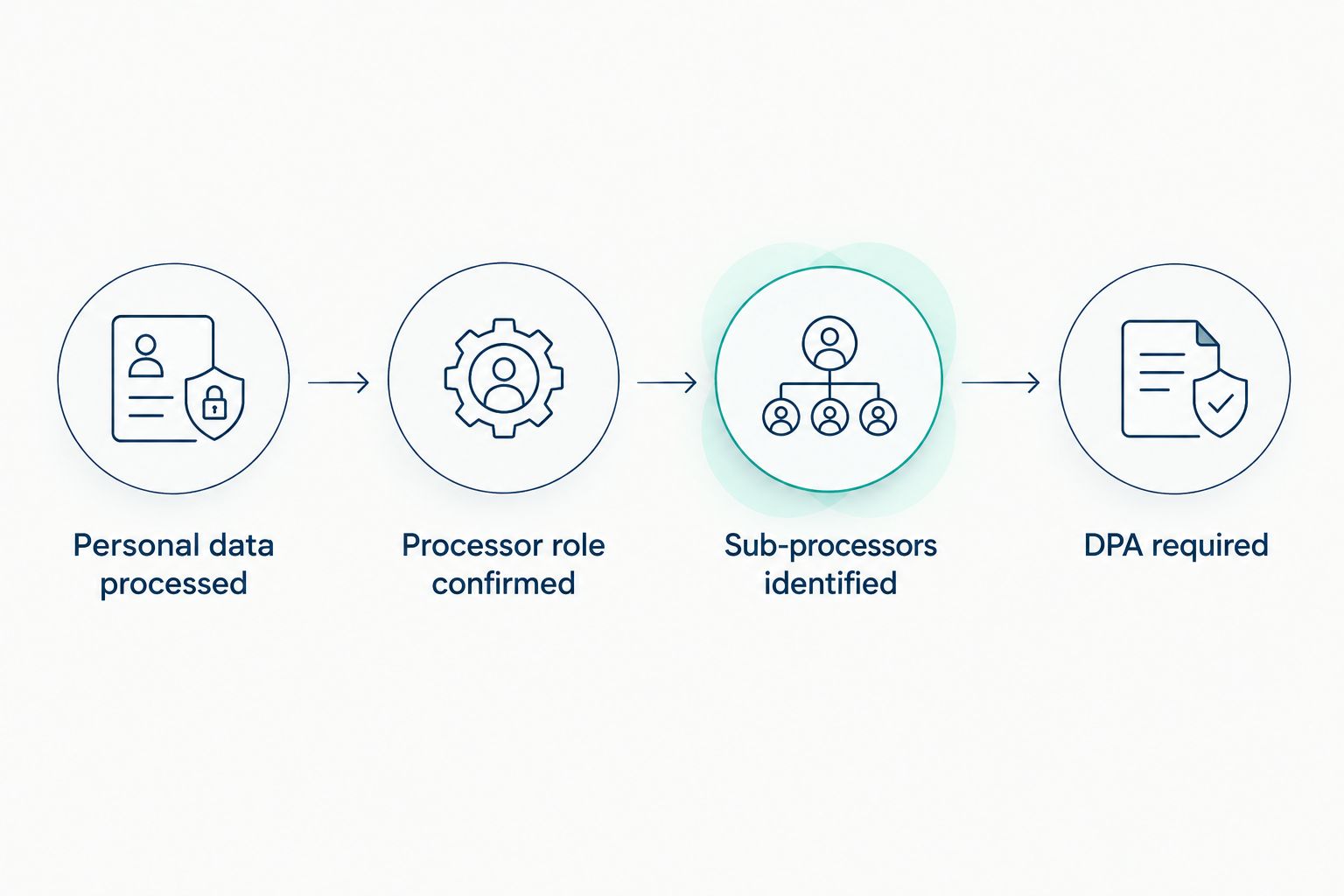
B2B SaaS with business-only data: DPA usually not required
When the platform processes invoices, inventory counts or aggregate usage metrics with no natural person attached, the customer relationship sits outside GDPR's processor definition entirely. This is the one category where no DPA is the correct answer, not an oversight. Confirm this with a data map before relying on it — one support ticket containing a customer's employee's email address moves the relationship into processor territory.
SaaS processing employee or end-user personal data: DPA required
CRM tools, HR platforms, analytics suites and anything storing end-user profiles fall here. The SaaS provider is the processor, the customer is the controller, and Article 28 requires a written contract covering the subject matter, duration, nature and purpose of processing, the categories of data, and the obligations of both parties. This is the largest category of SaaS contracts in 2026, and it's where most missing-DPA risk sits. Bringing a SaaS startup into GDPR compliance starts with mapping which customer contracts fall into this bucket.
SaaS acting as a sub-processor: DPA required at every layer
When a SaaS platform sits inside another vendor's stack — a support tool embedded in a marketplace, an analytics layer inside a bigger platform — the chain runs controller to processor to sub-processor. Each link in that chain needs its own written agreement, and the sub-processor's terms need to flow back up to what the controller actually promised its own customer. Skipping the sub-processor layer is the most common gap found in DPA reviews, because the direct customer contract looks complete on its own.
Why the DPA requirement varies
- Role in the relationship — controller, processor or joint controller changes which obligations apply and who drafts the paper.
- Type of personal data processed — contact data carries lighter obligations than health, financial or biometric data.
- Use of sub-processors — hosting providers, support tools and analytics vendors each add a layer that needs its own coverage.
- Cross-border data transfers — moving data outside the EEA triggers Standard Contractual Clauses on top of the base DPA.
- Sector-specific rules — healthtech and fintech SaaS carry additional regulatory layers beyond GDPR alone.
- Existing master service agreement — some MSAs already fold in data processing terms, which changes what still needs to be added separately.
“If your SaaS platform touches one CRM record with a customer's employee's name, you're a processor — sign the DPA.”
A generic template gets the base clauses right and misses the parts that actually carry risk: the sub-processor list, the transfer mechanism, and the audit rights a customer's procurement team will actually check. Lina's senior lawyers review and negotiate the DPA itself while AI agents handle the volume drafting — SaaS contracts covering IP, data and liability get a fixed-fee quote within one hour and typical delivery around 36 hours once scope is confirmed.
Related questions
Do I need a DPA for a free trial user?
Usually no, if the trial only collects a signup email and no other identifiable data — the relationship stays below the processor threshold until the trial account starts storing customer records. Once a trial converts to a paid account that stores end-user or employee data, the DPA requirement kicks in at that point, not before.
Is a DPA required if the SaaS company doesn't store personal data on its own servers?
Yes, if a sub-processor (cloud host, support tool, analytics vendor) stores it on the SaaS company's behalf — the obligation follows the data, not the server location. The SaaS provider stays the processor of record even when a hosting vendor physically holds the database.
Can one generic DPA template cover every customer?
No, not reliably — a single template misses sub-processor lists, transfer mechanisms and audit terms that differ by customer and by data type. Templates work for the base clauses; the sub-processor annex and transfer terms need customer-specific review, especially for 2026 contracts moving data outside the EEA.
FAQ
Does every SaaS customer need a DPA?
No. A DPA is required only when the SaaS provider processes personal data as a processor under GDPR Article 28. Contracts limited to aggregate or anonymized business data usually don't need one.
What is a Data Processing Agreement in SaaS?
A DPA is the written contract required by GDPR Article 28 between a controller and a processor, covering the subject matter, duration, data categories and obligations of processing. In SaaS, it usually sits alongside the main commercial contract as a separate schedule.
What happens if a SaaS company skips a required DPA?
Missing a required DPA exposes both the SaaS provider and its customer to GDPR Article 83 penalties, which reach up to €20 million or 4% of global turnover, whichever is higher. It also stalls enterprise procurement reviews that now check for the DPA before signature.
Can a SaaS provider use one generic DPA template for every customer?
A generic template covers the base clauses but usually misses the sub-processor list and transfer terms specific to each customer relationship. Customer-specific review matters most for deals involving cross-border data transfers or multiple sub-processors.
Who signs the DPA, the SaaS vendor or the customer?
Both parties sign — the SaaS vendor as processor and the customer as controller (or joint controller in some setups). The signed DPA usually attaches to or references the main commercial contract.
Does a DPA replace the main SaaS contract?
No, the DPA is a separate document that sits alongside the commercial contract and covers data processing terms specifically. It does not replace pricing, service levels or liability terms set elsewhere in the agreement.
How long does it take to draft a SaaS DPA?
Turnaround depends on scope and the number of sub-processors involved, but a fixed-fee quote is typically confirmed within one hour and delivery follows in about 36 hours once scope is agreed. Complex cross-border transfer clauses can extend that timeline.
Is a DPA required for a SaaS product with no personal data at all?
No — if the platform genuinely processes only aggregate or anonymized business data with no way to identify a natural person, the GDPR processor definition does not apply. Confirm this with an actual data map rather than an assumption, since one support ticket with a name in it changes the answer.
Get your SaaS DPA reviewed
Lawyer response within 30 minutes, fixed-fee quote within an hour.
One last thing
The question procurement teams ask first in 2026 isn't "do you have a DPA" — it's "who are your sub-processors and where do they host." A SaaS company that can answer that in one paragraph closes faster than one that scrambles to build the sub-processor list after the customer asks for it.
![[FR] LBO : pourquoi l’avocat doit structurer dette, gouvernance et garanties](https://gwvckixiegkllthleuyt.supabase.co/storage/v1/object/public/workspace-article-images-public/fb900cda-71ea-45a0-bc6b-f8a8d3dd765b/featured.jpg)
![[EN] Management fee agreements: how to document services and pricing](https://gwvckixiegkllthleuyt.supabase.co/storage/v1/object/public/workspace-article-images-public/dbcec8c2-5f61-4e58-bd49-8d313c594938/featured.jpg)
![[NL] Aandelenoptieplan opzetten: van bestuursbesluit tot eerste grant](https://gwvckixiegkllthleuyt.supabase.co/storage/v1/object/public/workspace-article-images-public/3d1770dc-0ee6-427b-a561-0f016fee655d/featured.jpg)